PlannerOS
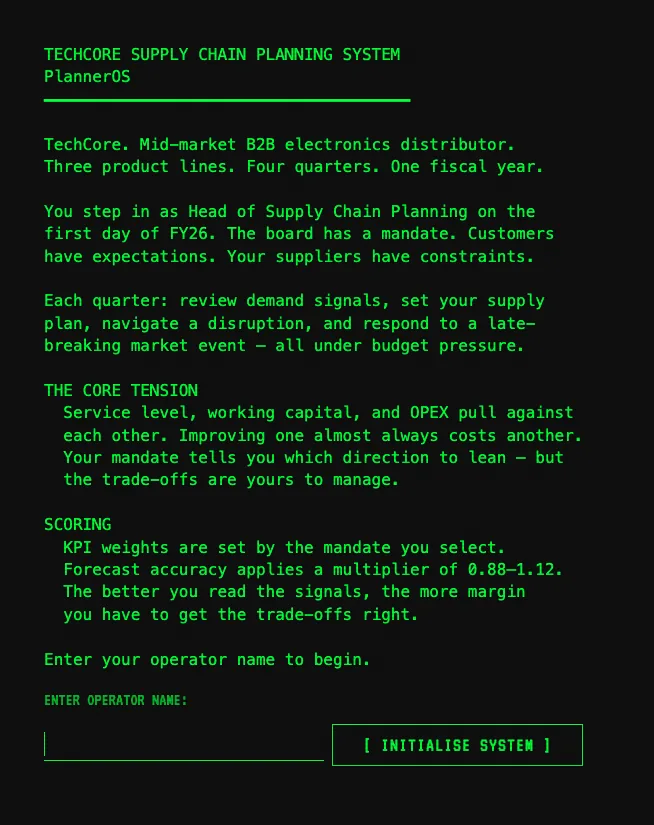
A browser-based supply chain planning simulation for consulting workshops — four quarters of decisions, real pressure, a live leaderboard, and a post-game debrief that maps your choices to one of six planning archetypes.
The problem
Supply chain professionals know the classic trade-offs between service, stock and cost in theory. What they rarely get is the feeling of making those calls under time pressure, with incomplete information and consequences they can’t take back. Slides don’t create that pressure, so I wanted a safe place to feel it.
What I built
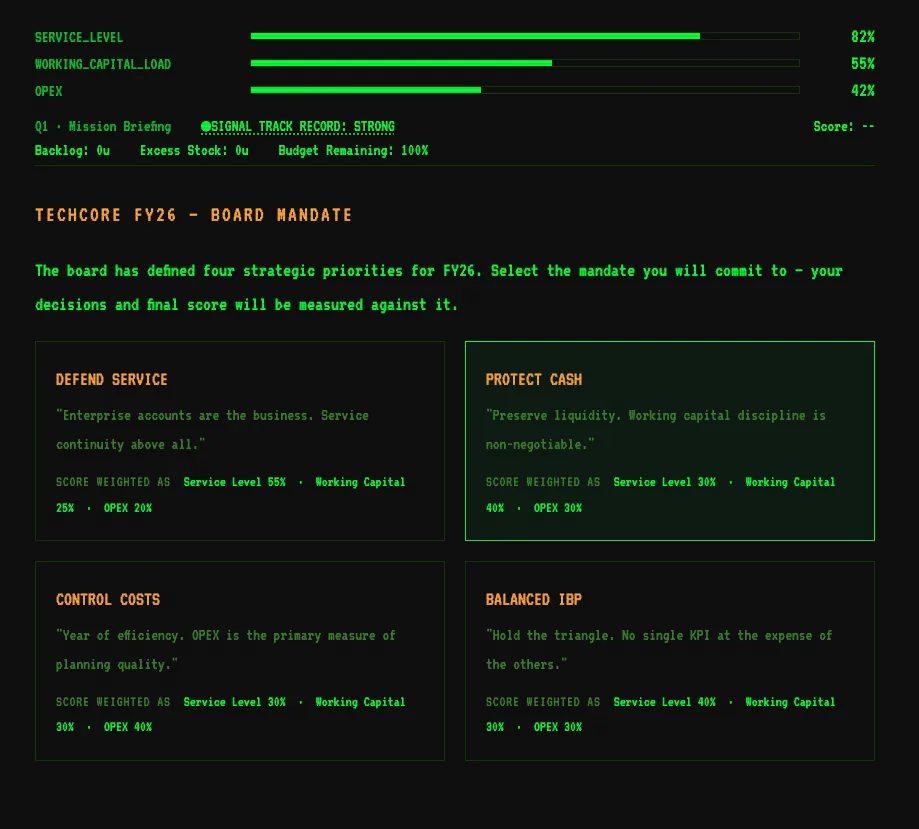
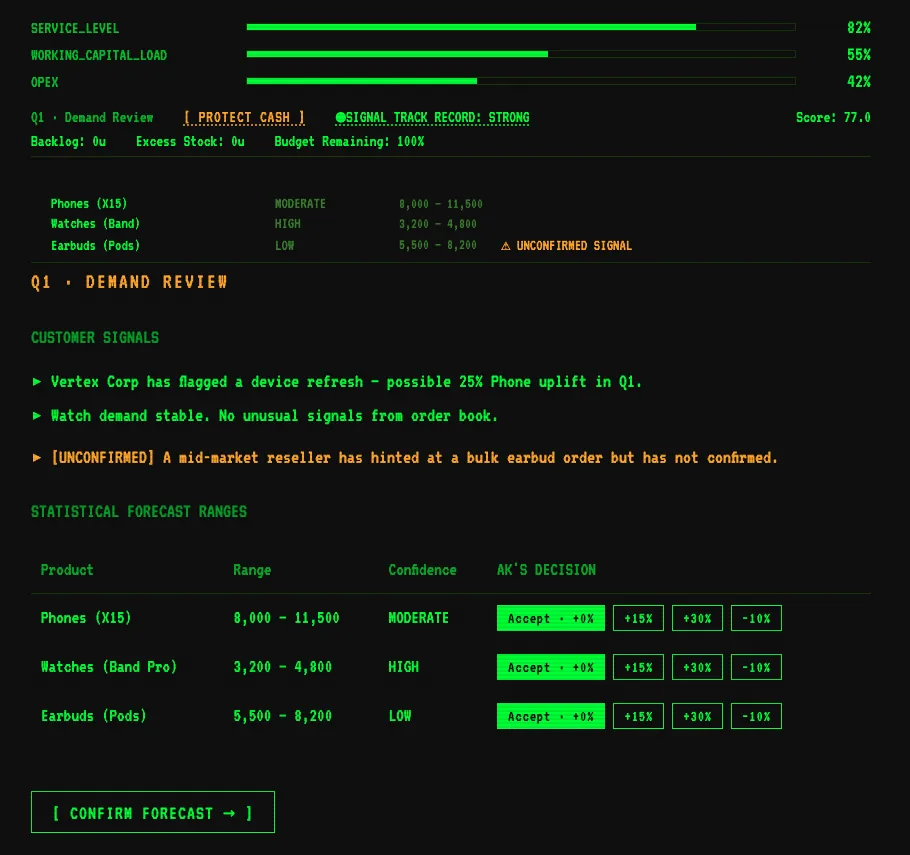
A browser game that makes you Head of Supply Chain Planning at a fictional electronics company for four quarters. The board sets a priority (defend service, protect cash, control costs, or balance all three), and each quarter you read the demand signals, some real and some noise, commit to a plan and live with what the market throws back. At the end, a debrief sorts your decisions into one of six planning styles, each tied to a real planning concept. In a workshop, everyone’s scores climb a shared leaderboard in real time.
The game logic is pure functions, so the same inputs always give the same outcome, which made it quick to tune and easy to trust. One demand signal each quarter is randomised when a session starts rather than mid-game, so every playthrough differs but nobody is blindsided halfway through.
Tech stack
Architecture
The hard part
The hard part was deciding what to hide. Show every number and the game becomes a spreadsheet; hide too much and it feels arbitrary. So information is layered: some figures are always on screen, some appear only as a vague status with no number, and some stay hidden until the debrief. That gap creates the tension, a constraint players feel but can’t quite see, and it makes the debrief land: “that’s why you ran out of cash.”
How well you read each quarter’s demand signal also follows you: your accuracy across the year multiplies your final score, so a lucky guess and a well-judged read don’t end up looking the same.
Screenshots
Outcomes
- Live at planners-os.vercel.app ↗ — used at practitioner events for groups of 15–20
- V1 and V2 both shipped in a single day; V2 built directly on feedback from first players
- 5,184 possible playthroughs from the different combinations of mandate, signals and events
- Six planning styles (Rapid Responder, Buffer Builder, Lean Forecaster, Efficiency Guardian, Customer Champion, Orchestrator), each mapped to a real supply chain framework in the debrief
- Discussed with the practice’s learning-and-development team as a training module